
Description
Aldebaran Bullseye Talisman Description
The Left Eye of the Bull in the Taurus constellation, Aldebaran is considered to be one of the so-called ‘royal Persian stars’ (alongside Regulus, Antares, and Fomalhaut). These four stars, referred to as Guardians or Watchers of the Heavens were, purportedly markers of the seasons deep in antiquity and were thought to herald world changing events. Of these four stars, Regulus tends to get the most attention in contemporary magical astrology (Fomalhaut has picked up steam as well, thanks to innovative work by Christopher Warnock and Kaitlin Coppock involving this star) but this does not reflect the way that Aldebaran had an ancient pride of place among the Behenian fixed stars. In De Quindecim Stellis, for example, Aldebaran is the first of the 15 stars listed and receives nearly twice the exposition of any other star except the Pleiades/Alcyone.
As with many of the Behenian fixed stars, while Aldebaran’s mundane significations are mixed and sometimes calamitous, its attested magical effects are uniformly positive. The Quadripertitus manuscript of Hermes on the Fixed Stars says that Aldebaran’s “virtue is to increase the wealth of [those] that beareth it, and to bestow great honor upon [them]” (De Quindecim Stellis, tr. Regulus Black).
Beyond these traditional magical significations we would add that Aldebaran—and these talismans are no exception—seems to convey a propulsion and persistence to the bearers of Aldebaran’s magic. Aldebaran can bring a kind of locomotive force that, although it can be somewhat challenging to steer, can push us toward our goals with an almost unstoppable potence. This is consistent with Aldebaran signaling seasonal renewal in the ancient Near East.
On this point, it’s worth bearing in mind that the Watcher of the East, alongside the other Archangelic stars, was most commonly put to practical effect as a navigational touchstone. Aldebaran’s strong connection to the imagery of the eye—the Eye of the Bull, God’s Eye, Eye of Illumination, Eye of Revelation—invites us to look closely at the symbolism of the eye, the gaze, and therefore vision in its literal and metaphorical senses.
In ancient optics, following Euclid’s postulates, the eye was thought not to receive the photons emitted from external sources as our contemporary physics would have it, but to emit rays that would grasp or comprehend what they struck or touched. This image invites us to conceptualize the eye as an active agent of intention. Just as an arrow flies where it points, the eye directs the body according to its aim, its vision, and hence its intention.
Etymologically, to intend means to stretch or tend toward. Ultimately, we stretch toward either what we desire or, if we are out of touch with our desires, what draws us in. Our desire determines our aim: we see according to what we want, and we stretch toward what we see. We are put in mind here of The Chariot in the Tarot deck (a card that came up during divination in support of one of our early Aldebaran workings), which invites us to reflect on whether we are in the driver’s seat or being driven by forces outside of our control.
This imagery dovetails with our personal experience of the vigor of these Aldebaran talismans, which resonates with what Manilius wrote in the Astronomica about the constellation Taurus: “It bows its neck amid the stars and of itself demands a yoke for its shoulders” (Book IV, p. 233). Those who would bond with such talismans would do well to possess clarity of purpose and a capacity to aim resolutely for the proverbial Bullseye, for the raw power of the Taurean bull demands clear intention, steadfast determination, and a sturdy hand to direct its awesome musculature toward profitable ends.
Absent a solid psychic architecture for channeling the passions of Aldebaran, we can risk a misfire or casual discharge of the Bull’s propulsive force in the proverbial china shop. When we set our sights on something we can get carried away or swept along with the tide of our impulses. When we lock in to a project with full focus and charge straight ahead, we can risk becoming short-sighted or myopic (literally: ‘closing the eye’ and thus being unable to see), missing out on the bigger picture beyond our laser focus. As with the running of the bulls, one does not convince the bulls to stop or slow down: one gets out of the way. In short, when considering whether to invite such a potent spirit into one’s life, it would be prudent to ensure there won’t be any stray powder kegs about, or at least that one has a (metaphorical) fire extinguisher on deck.
Aldebaran wants what it wants and forges ahead. This gives these talismans a ‘won’t stop until the job is done’ quality. The benefits that come from Aldebaran are not the kind of riches that are easily enjoyed from the lap of luxury, but rather the hard-earned goods that come from the tilling of hard earth or even a ‘get rich or die trying’ attitude.
The ancient astromagical text De Quindecim Stellis highlights the Martial nature of Aldebaran, stating that Aldebaran is of the nature of Mars and the complexion of Venus. The text goes on to highlight the importance of the Moon’s aspects to benefic planets when with this star, which has the effect of tempering the Martial fury of Aldebaran: “if the Moon should be with Aldebaran and beholding Jupiter or Venus… [it will] possess the same signification as though [Aldebaran] were with Venus within the same degree and minute” (p. 20). Furthermore, when Aldebaran is on the Ascendant or Midheaven—as it must be in fixed star talismanic elections—and “it should be fortunate because of Venus, it indicate[s] mildness” (ibid). As you can read about below, this particular election features the Moon applying simultaneously to Aldebaran, Jupiter, and Venus, with Venus applying to a sextile with Aldebaran as well. While the Martial nature of this star cannot be overridden—the Eye of the Bull gazes out and charges at what it intends to charge at—it can be and is here tempered by Venus.
Notably, the magical image of Aldebaran used for talismans is not a bull as one might expect (which is in fact one of the magical images of the fixed star Alkaid), but “the likeness of God or of a man flying” (Agrippa, Three Books of Occult Philosophy, Book II, Chapter 47). These images suggest the need for a “higher” governing of the raw animal power of this Martial star, befitting its stature as not merely angelic but archangelic, associated with the archangel Michael in particular. When we possess the rational-spiritual fortitude to harness, refine, and direct our desires according to more authentic and noble aims, however, we can invite the Bull to stretch toward the Riches & Honors that ultimately better suit us.
PLEASE NOTE: As with any gold-plated jewelry, the gold-plating on these talismans (and chains) will rub off over time with normal use and expose the sterling silver beneath. This will not affect the functioning of your talisman in any way, and is a purely aesthetic phenomenon.
Technical Details
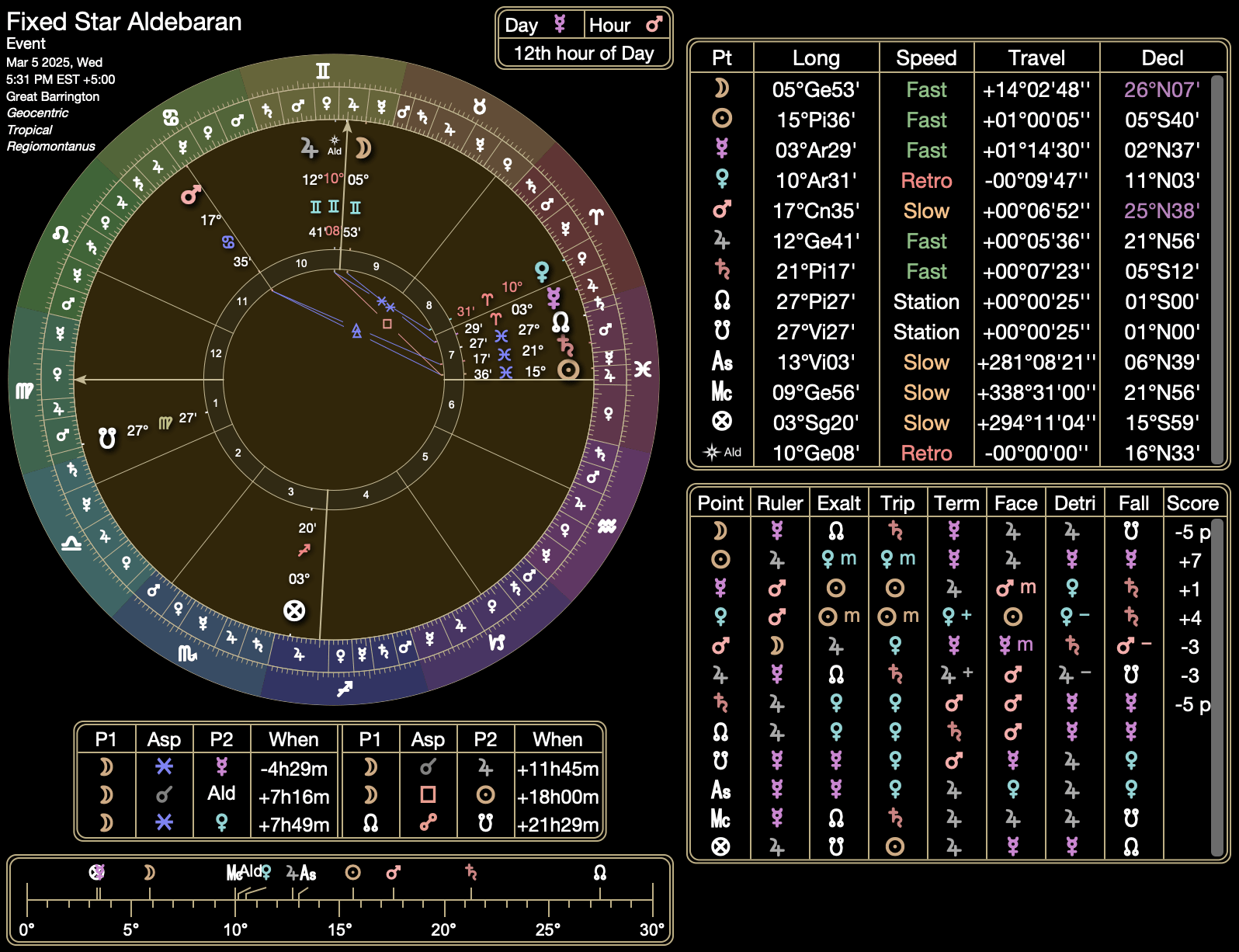
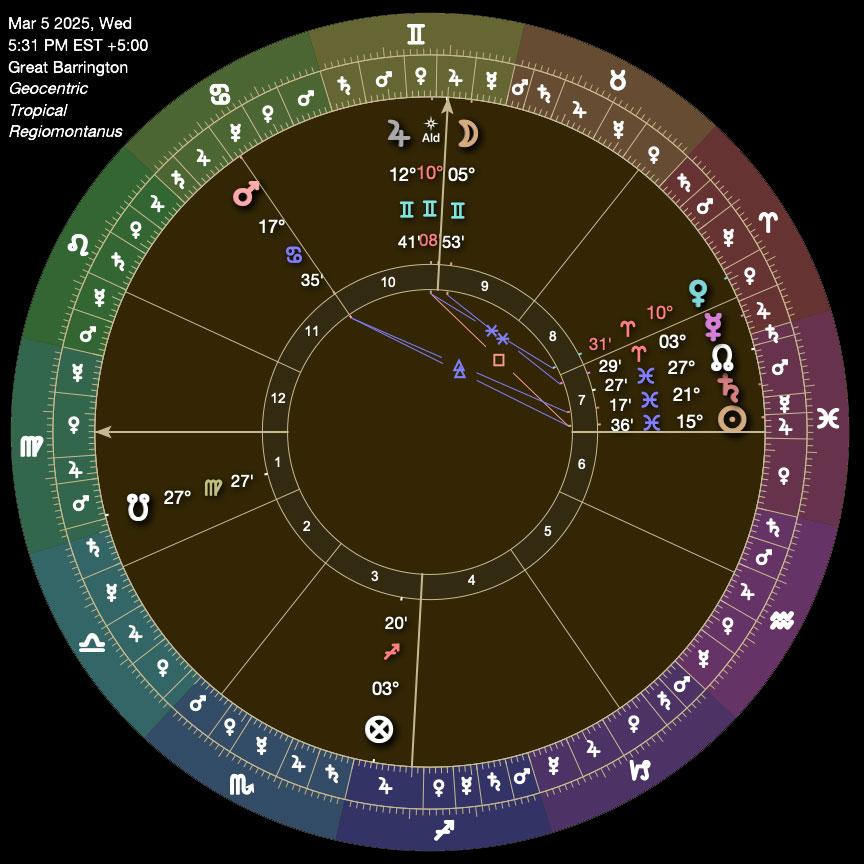
The fixed star Aldebaran Bullseye talismans were ensouled during the afternoon of Wednesday, March 5, 2025 between 5:21pm and 5:42pm EST.
Essential Features of the Election
For fixed star astromagical elections, we require that the relevant fixed star either rises on the Ascendant or culminates on the Midheaven. In this election, the fixed star Aldebaran at 10◦06’ Gemini was culminating on the Midheaven and the working took place while Aldebaran was within 2◦30’ of the MC.
Fixed star elections also require the Moon to be in sufficiently good condition and applying to the relevant fixed star. Idola Stellarum only uses lunar conjunctions to fixed stars. In this election, the Moon was applying to a conjunction to Aldebaran within 5◦. The Moon was moving with fast speed, increasing in light approaching the first quarter, and was not afflicted by either malefic planet (Mars was in aversion and Saturn was more than 15◦ away from a square, well out of orb). The Lord of the Moon was also in acceptable condition, which we will now examine.
Since the 1st house signifies the bearer of the talisman, we also look at the condition of the Lord of the Ascendant in talismanic elections. In this election, Mercury, the Lord of the Ascendant, Virgo, was in acceptable condition. Mercury was peregrine and angular, and was not afflicted by either malefic planet.
Note that for fixed star talismans, planetary hour and/or day are not essential considerations.
Further Magical Factors in the Election
Both the Moon and her lord, Mercury, were making aspects to both benefic planets in this election. The Moon was making a sextile to Venus and a conjunction to Jupiter, while Mercury was applying to a conjunction with Venus and a very wide sextile to Jupiter (out of orb). Although both of the benefics were afflicted (Jupiter was in detriment in Gemini, and Venus was in fall and retrograde in Aries), Picatrix considers any aspect to a benefic to be positive no matter whether it is afflicted or not. Jupiter was also square the Ascendant in this election, with a particularly close aspect during the invocation and carving of stones. The strong influence of the benefic planets in this election tempers and sweetens some of the fiery ebullience of the Sovereign Bull.
Reflection on Weaknesses of the Election
The primary weakness of this election was the fact that the Moon was separating from her ruler, Mercury. This flaw in the Moon’s condition was mitigated somewhat by the presence of Jupiter on the MC during the entire window of the election, since having a benefic planet on the Ascendant or Midheaven also serves to mitigate afflictions of the Moon:
“[L]ook for Jupiter or Venus either in the ascendant or in the tenth place, for so they compensate for the debilities of the Moon.”
—Marsilio Ficino, Three Books on Life, Book III, Ch. VI, p. 271 (tr. Kaske & Clark)
We also note that the Greater Malefic Saturn was angular in this election. Although the Ascendant and Midheaven are the most sensitive angles in the chart, any angularity of a malefic planet is not ideal. When malefic planets are in angular houses, we always make sure to keep the planet at least 5◦ away from the angle. In this election, Saturn was kept more than 6◦ from the DC during the entire electional window and more than 7◦ away during the carving of the stones (the tail end of the election is used for affixing the herbs and suffumigation).
Recommendations
The high-octane nature, sheer intensity, and single-mindedness that can come from the influence of Aldebaran suggest that this talisman may be unsuited for people who consistently struggle to intentionally direct their emotional energies or attend to their essential needs. For such folks, we recommend having firmly in place personal/ritual/devotional practices or spirit relationships that furnish equanimity and prudence toward their instinctual life and desires.
People whose natal charts feature malefic planets (Mars or Saturn) within a few degrees of 10◦ Gemini, Virgo, Sagittarius, or Pisces are encouraged to divine on how well this talisman would fit for them at this time.
Ceremonial Details
Gemstone & Talismanic Image
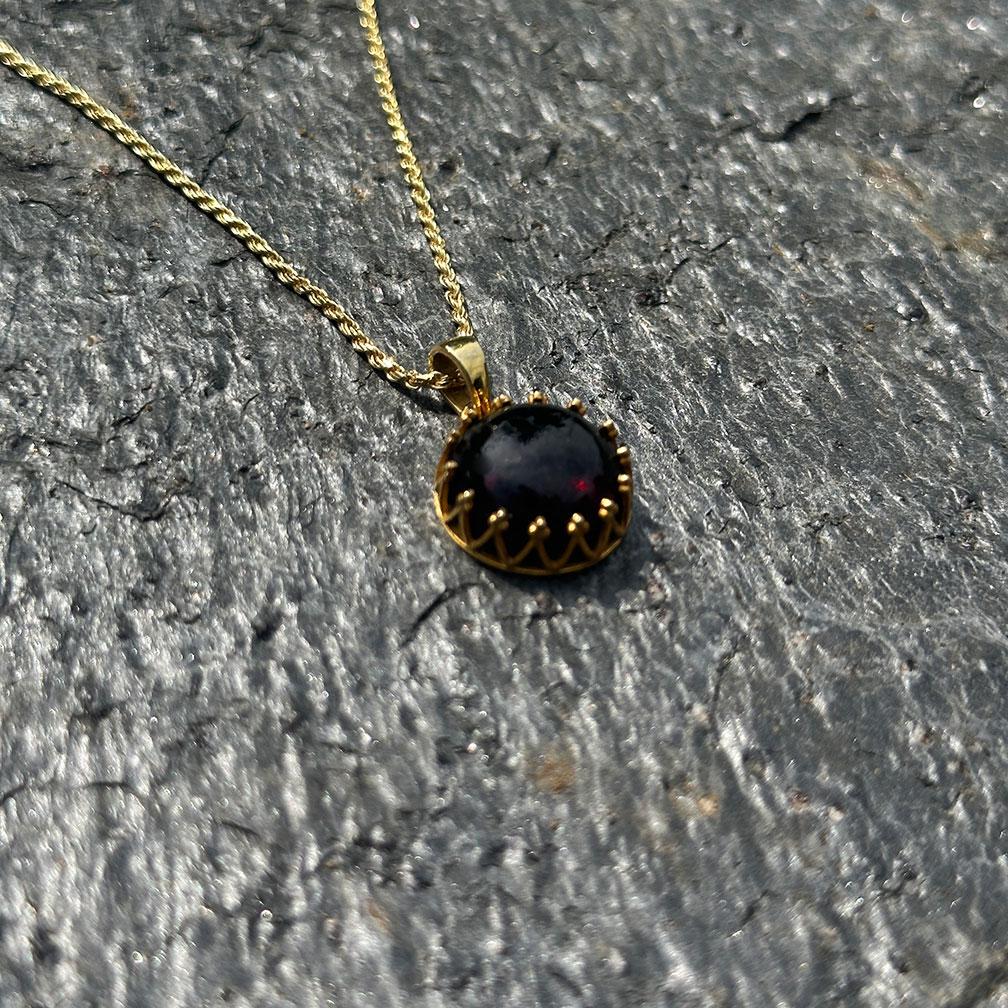
The ruby and the ‘carbuncle,’ a term that once referred to a variety of red stones but most often to granatus, or the stone known in modern English as garnet, are the traditional stones of Aldebaran. Albertus Magnus, in his lapidary text De Mineralibus, says that these stones are “said to have more powers than all other stones.” Magnus also states that garnet or granatus “is said to gladden the heart and dispel sorrow” (p. 96). The Peterborough Lapidary states that the garnet “excites and stimulates the blood” (tr. Francis Young, pp. 9-10). The medieval lapidary of King Philip assigns carbuncle to the archangels, among the nine orders of angels (Magical Jewels of the Middle Ages and the Renaissance, Joan Evans, p. 79).
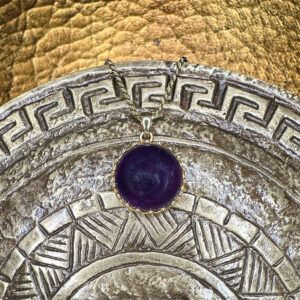
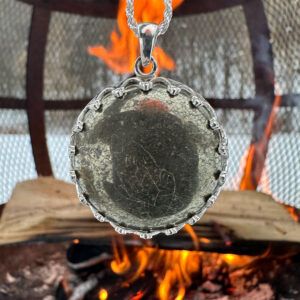
For this election, 15mm granatus (Indian garnet) cabochons were engraved on the front with the image of “a flying man” fashioned after imagery of the angel of the Lord. The sigil of Aldebaran from Agrippa’s Three Books of Occult Philosophy was carved on the back of the stone.
The most popular herb association for Aldebaran has been milky thistle due to the Donald Tyson translation of Agrippa’s Three Books of Occult Philosophy. Guided by the more recent translation of De Quindecim Stellis by Regulus Hess and confimed by divination, however, we used a combination of spurge and honeysuckle as both suffumigation and herbs affixed to the back of the stone.
Ritual Setup
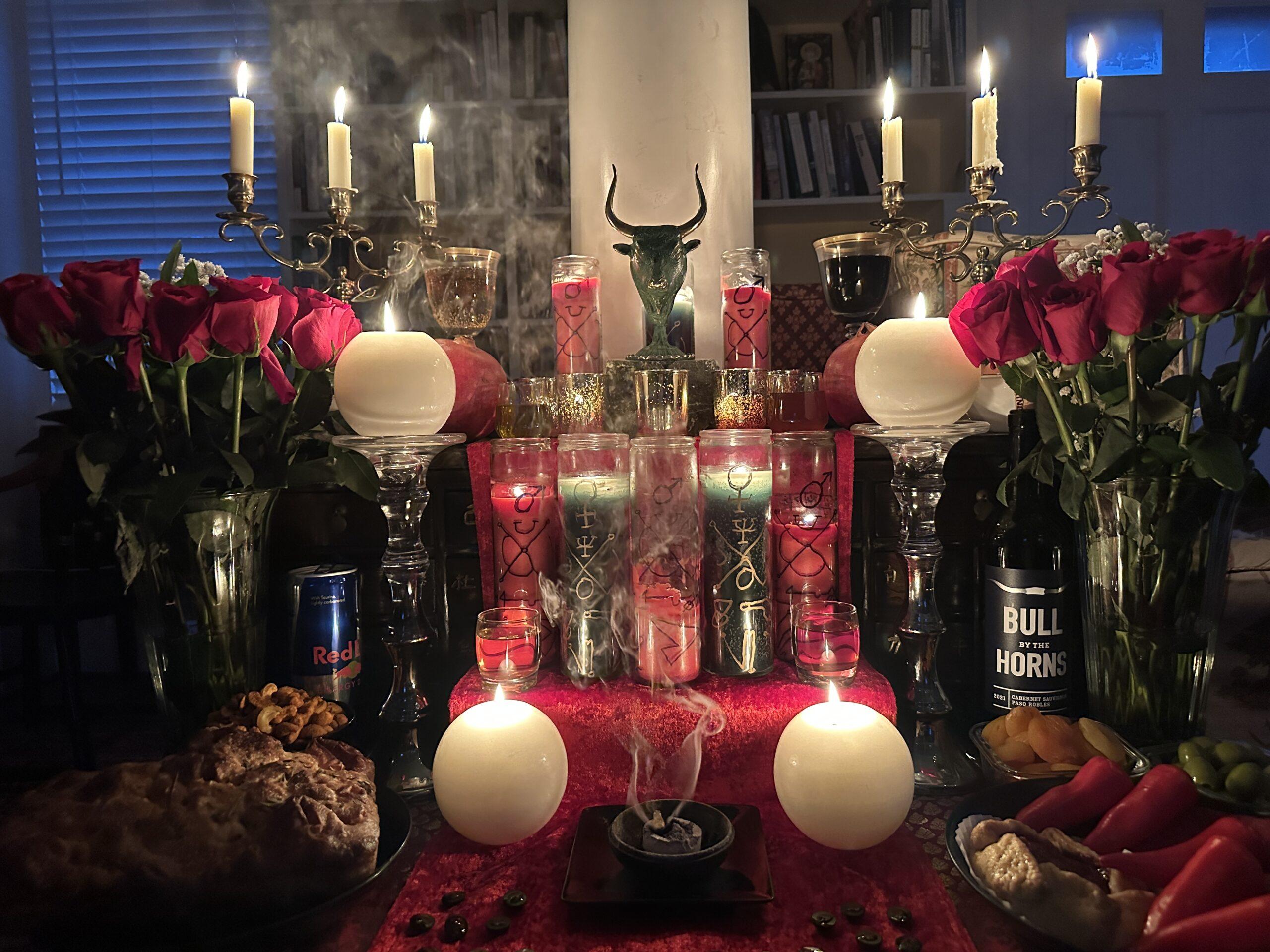
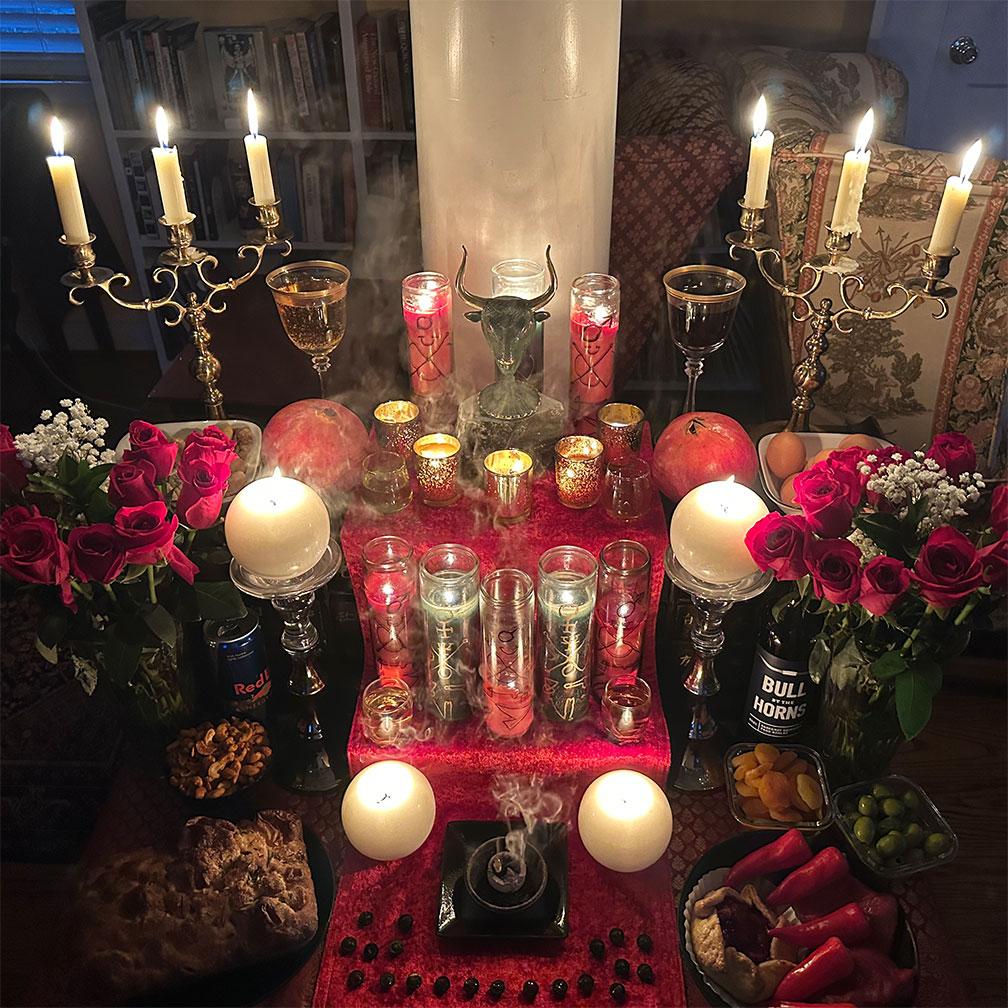
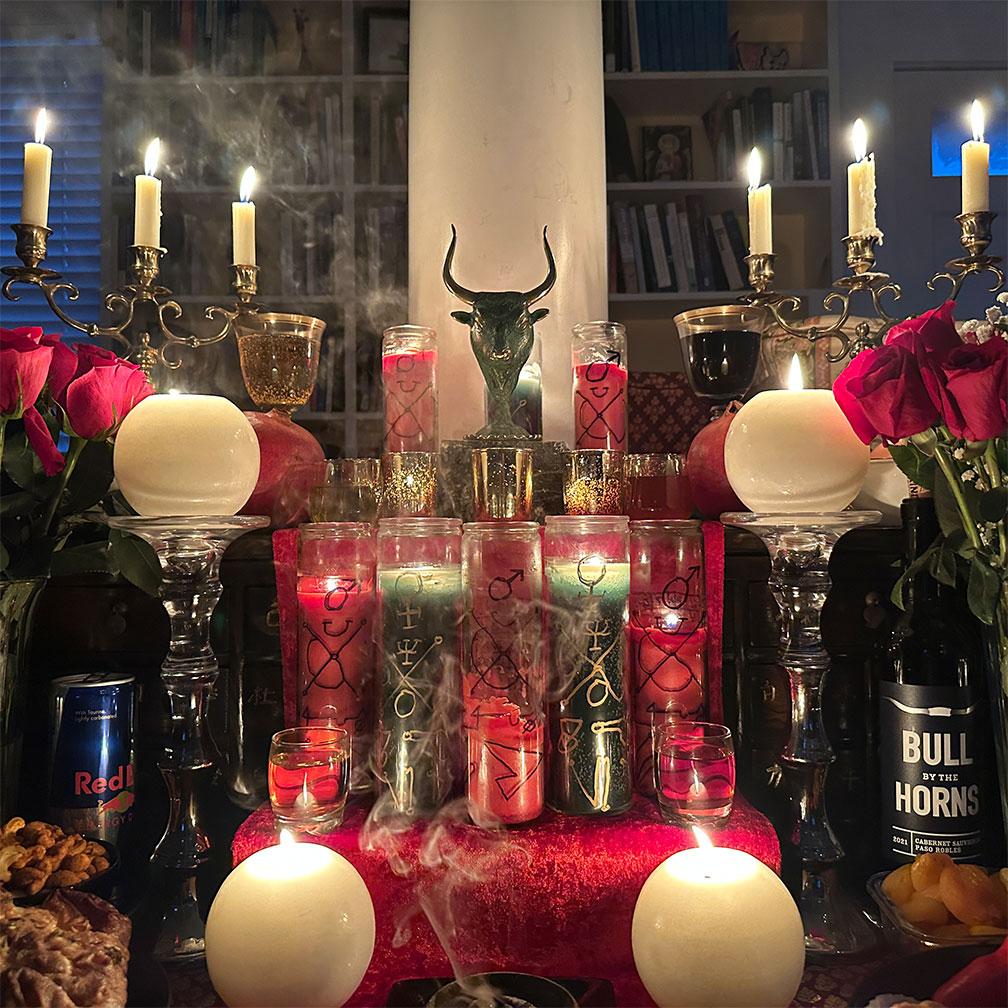
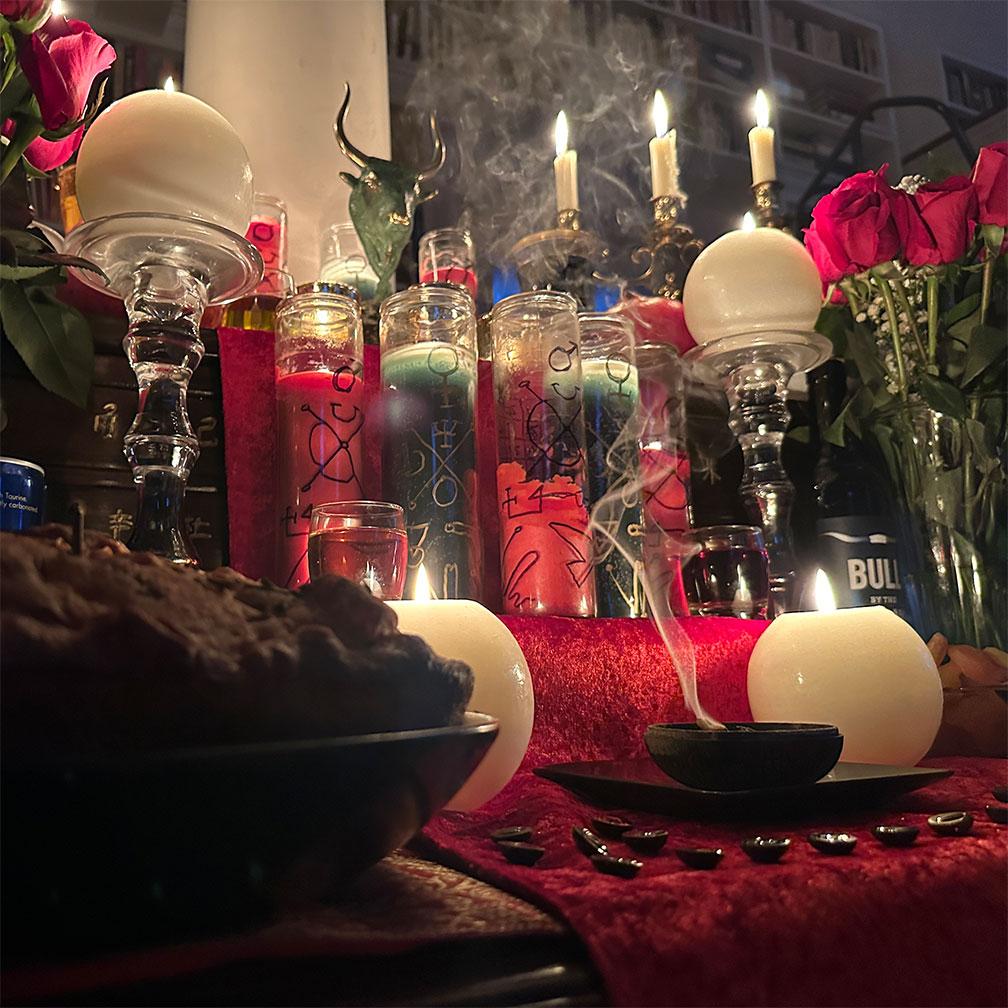
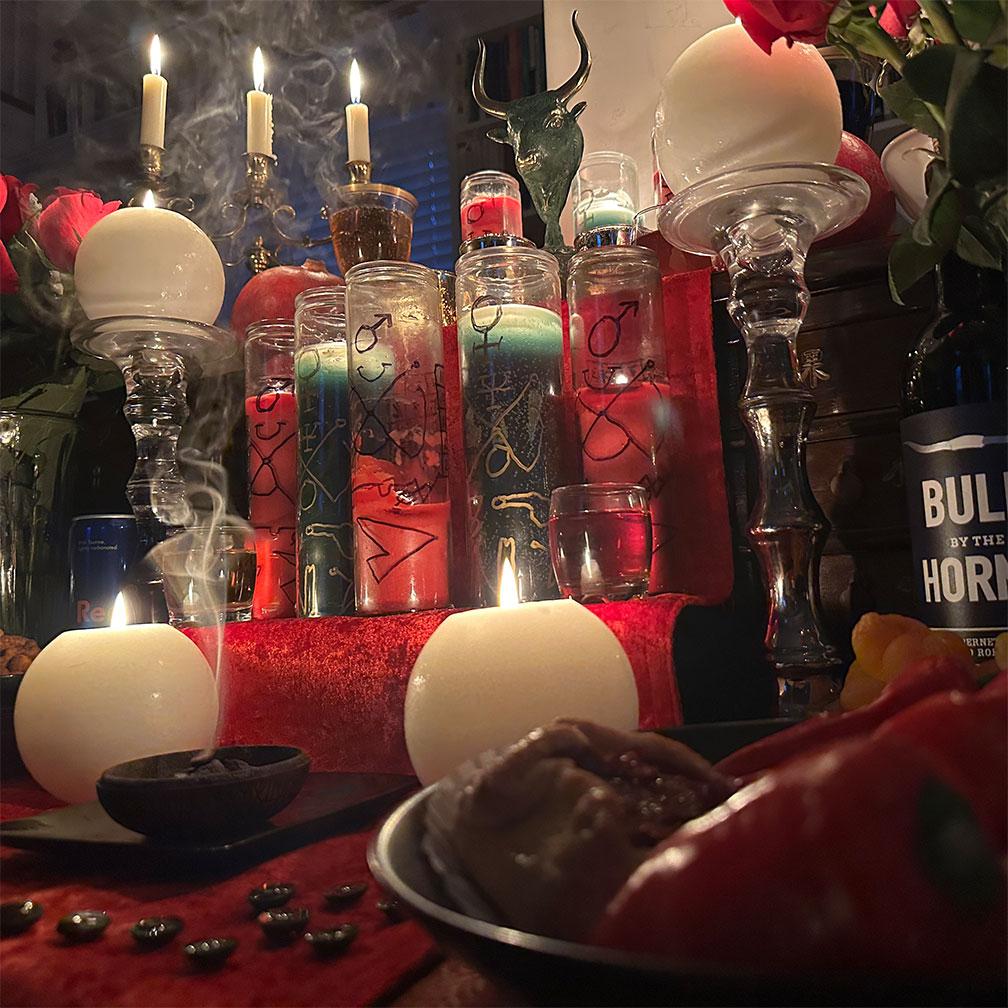
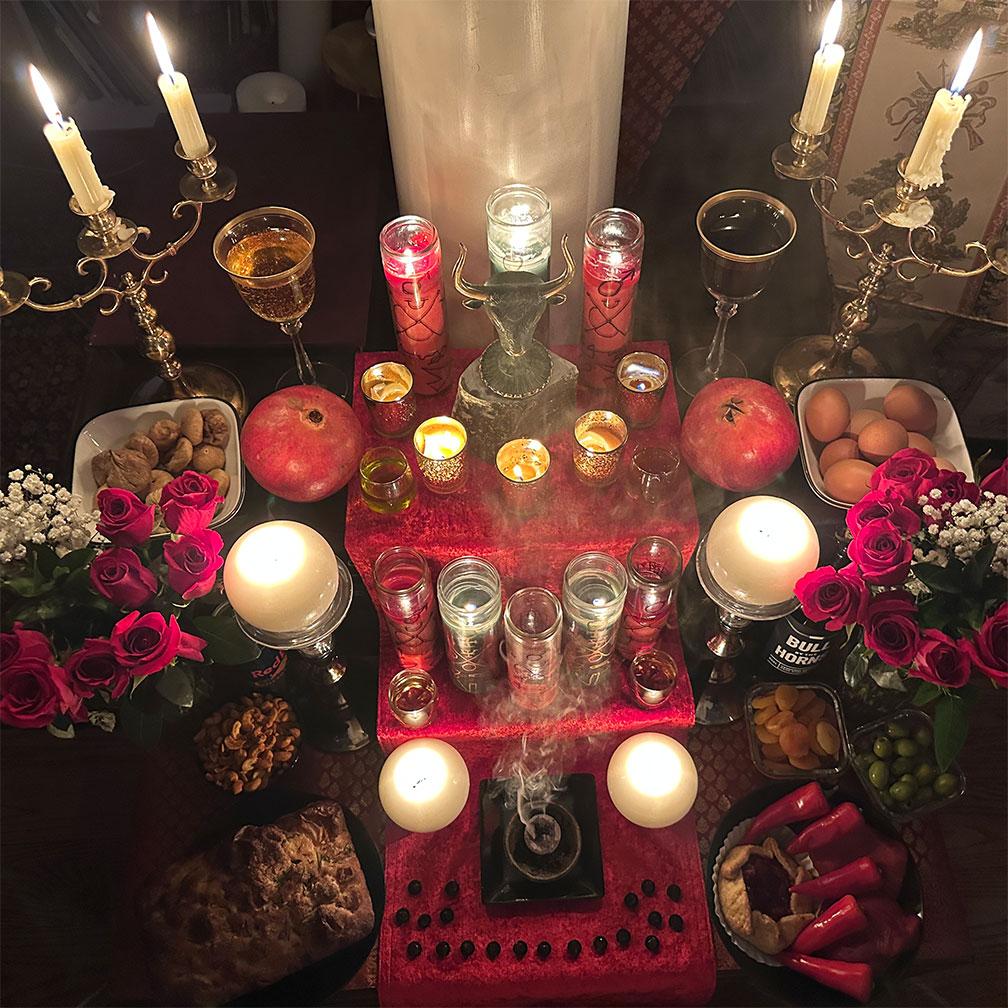
Befitting the Martial nature of Aldebaran, a ruby red altar adorned with a red and gold cloth and a red velvet cross cloth was established prior to the working, emblazoned with red and green candles ritually consecrated to Mars and Venus, respectively. Food and spirit offerings appropriate to the occasion were offered, and a dozen red roses fleshed out the color scheme. Finally, a 16oz can of—what else?—Red Bull (echoing both the wings of the flying man image of the talisman and the nature of the star itself) was offered along with ‘Bull by the Horns’ cabernet souvignon. The altar was constructed opposite our usual ritual space, since this working took place the very same day as the operation for our Perseus constellation Athena’s Shield talismans, which forced us to get a little creative about our setup.
Suffumigation
Suffumigation and incense offerings consisted of a combination of spurge and honeysuckle (see above) with the highest quality Sumatran Gold Seal Dragon’s Blood resin.