Description
[CW: War, AIDS crisis, Epstein files.]
Mirth & Joy? In this economy?
Are you serious?
We’re always serious. Mirth and joy are serious business—not for the faint of heart, least of all in times like this.
From a certain position in the contemporary Western worldview, major signature stylings of Venus—”splendor, preciousness, word games, delight in music, joy, adornments, laughter,” and so forth (Picatrix, bk. III, chap. 7, tr. Greer & Warnock)—might seem unserious, even undignified. But dignity as we have received the notion in the so-called West possesses a definite narrowness of spirit. A dominant image of dignity, informed by centuries of unsmiling faces staring grimly back from the cold metal of stamped coins, is saturated with a certain staid joylessness. This sort of dignity might even seem to be called for now: at a time when the tides of war are rolling in and authoritarian surveillance and control pervade our lives, don’t we need to meet the moment with a steeled resolve? If so, it might seem that Venus can’t be the answer.
We would argue that this skepticism toward Venus is because the astrological imagination has become somewhat impoverished when it comes to our laughter-loving Queen. If we delve beyond the first millennium from which many of our contemporary significations of Venus derive, we find that in the pre-Classical Near East, the planet we call Venus was associated with the Mesopotamian goddess Inanna, who in addition to being a goddess of love, fertility, and sex was also quintessentially a goddess of war. In a prayer translated from the Sumerian by Jane Hirschfield, Inanna is portrayed as “rain[ing] fire on the heads of men” and being “in the forefront of the battle.”
Because of Venus’s presumed femininity and association with women, and how such aspects of humanity have been taken up by millennia of patriarchal cultures, Venus may very well be the most devalued planet in astrology even as she is co-opted by trans-exclusionary feminists and other forces of that same patriarchy. But just as much as the world needs people out in the streets and fighting for what is right, it is just as important to nurture, preserve, and create a world worth fighting for. Consider Aristophanes’s comedy Lysistrata, in which the titular character persuades the women of the warring cities to withhold sex until peace talks are held, providing a vivid example of how the gears of war grind to a halt without the, ah, shall we say, lubrication that Venus’s influence canonically supplies. In a more modern context, the LGBTQ+ activist Dan Savage is famously reputed to have said the following:
“During the darkest days of the AIDS Crisis, we buried our friends in the morning, we protested in the afternoon and we danced all fucking night. The dance kept us in the fight because it was the dance we were fighting for. It didn’t look like we were going to win then and we did. It doesn’t feel like we’re going to win now but we could. Keep fighting, keep dancing.”
Serious indeed—even dignified.
These Mirth & Joy talismans are our take on an election that many prominent and skilled astrological magicians participated in last year. Seeing so many people excited for the fruits of this election made us eager to share these talismans, but—serious as we are sometimes perhaps to a fault—we held fast to our safety protocols and guarantees and held onto these talismans through our standard six month testing period before making them publicly available.
The Mirth & Joy talismans invite us to ask: what would a world look like where everyone has access to their own joy and well-being? The dignity of the Venusian gets stripped away when joy and pleasure become commodified, when power preys upon the vulnerable and extracts profit and gain from unwilling bodies. No matter how much power, money, and influence were involved, there was absolutely not one single shred of dignity in what happened on Epstein’s island. The worldview that breeds such corruption is the antithesis of Venus’ sphere. When joy and pleasure are tied to a common good, a vision of a just world, and a sense of integrity, then they help us put our heart into creating a world worth fighting for. This is Venus.
We want to emphasize that these Mirth & Joy talismans do not promise a toxically positive ‘good vibes only’ experience: they will not transform every moment of your waking life into a pleasurable feeling, and really, in trying times like these, aiming for that would be irresponsible and probably dangerous. The Mirth & Joy talismans may, on the other hand, help usher in a more grounded sense of self-possession of one’s own pleasure and joy, especially when paired with and folded into a devotional relationship with Venus. Self-possession serves as a powerful antidote against despair and hopelessness, and renders us less vulnerable to forces that would seek to snuff out or exploit our joy. We leave you with one final thought from W.H. Auden: “As a rule, It was the pleasure-haters who became unjust.” Cultivating our own laughter-loving Venusian virtues—together—in a world that would revile them orients us toward justice in a grounded, embodied way that no rules nor order could ever touch.
Technical Details
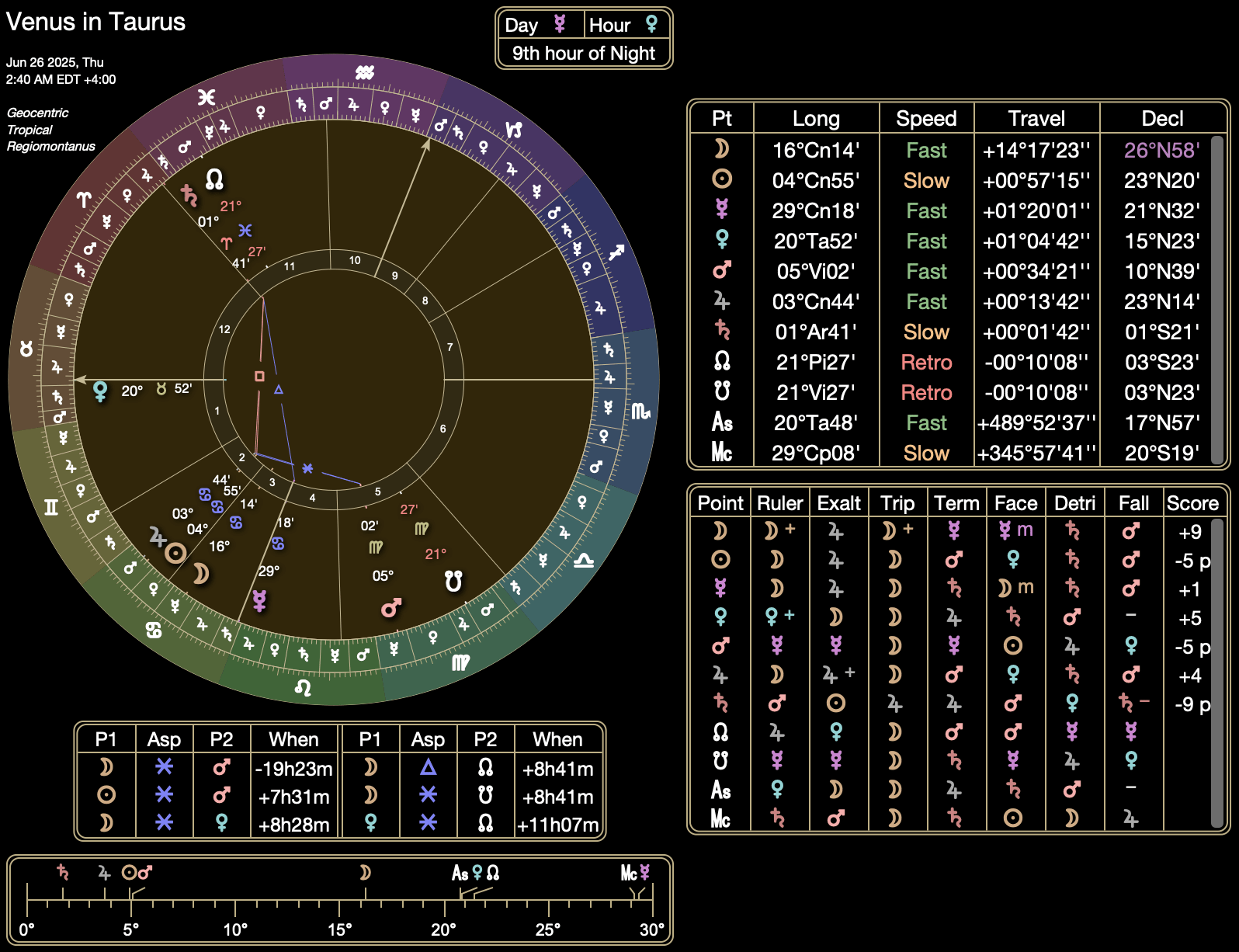
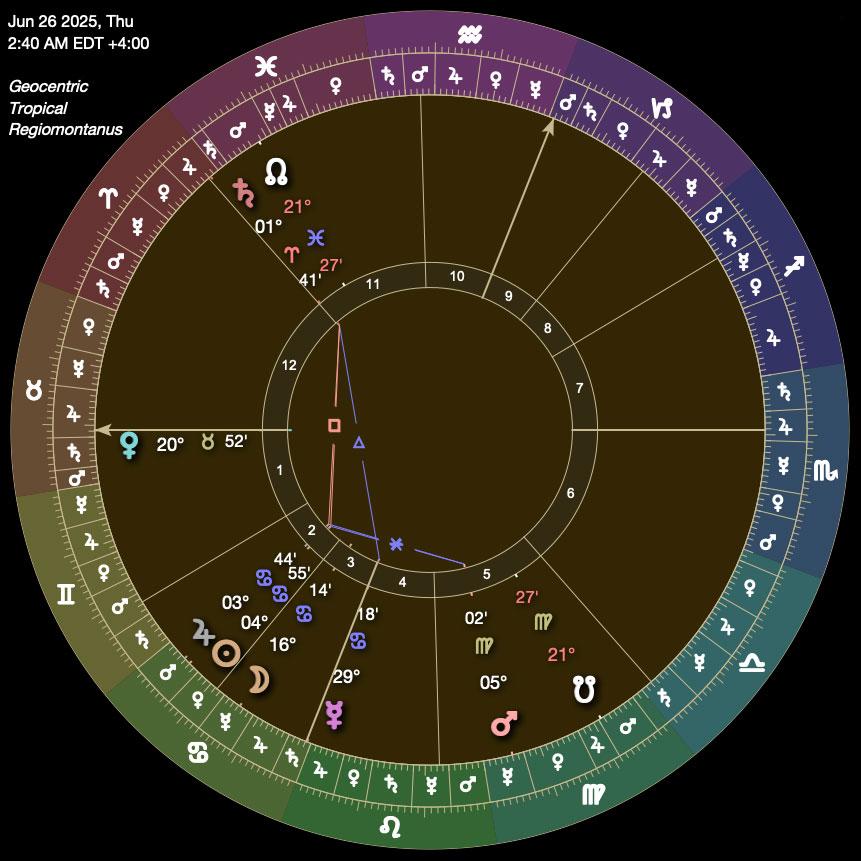
The Venus in Taurus Mirth & Joy talismans were ensouled during Venus hour on Thursday, June 26, 2025 between 2:26am and 2:55am EDT.
Essential Features of the Election
For planetary astromagical elections, we require that the relevant planet either rises on the Ascendant or culminates on the Midheaven during the relevant planetary hour. This election took place during Venus hour with Venus rising on and within 5° of the Ascendant during the electional window. Venus was unafflicted and dignified by domicile in Taurus.
Planetary elections also require the Moon to be in sufficiently good condition. During this election, the Moon was dignified by domicile in her home sign of Cancer as well as dignified by triplicity, and moving with very fast speed. Luna was also increasing in light, though was also just barely still under the beams of the Sun.
Since the 1st house signifies the bearer of the talisman, we also look at the condition of the Lord of the Ascendant in planetary elections. In this election, Venus ruled the Ascendant sign of Taurus, and so the same considerations for the significator apply here.
Further Magical Factors in the Election
Both Venus and the Moon were well outside of the orb of aspect to either malefic planet, and were both witnessed by exalted Jupiter in Cancer. The presence of Venus in the first house and Jupiter in the second house also fortunates the election. Maslama al-Qurtubi writes in Picatrix: “You should know that the ascendant is more fortunate and stronger if it has a fortune in the sign that is rising, and also in the second house” (Book II, Chapter 3).
Overall, this was a very strong Venus in Taurus election, which is reflected by the fact that many prominent astrological magicians created talismans during this election to positive effect.
Reflection on Weaknesses of the Election
As mentioned above, although there were many positive factors to the Moon’s condition, she was also afflicted by being under the beams. This weakness is lessened by having a benefic planet on the Ascendant or Midheaven (in this case, Venus was on the Ascendant), which serves to mitigate afflictions of the Moon:
“[L]ook for Jupiter or Venus either in the ascendant or in the tenth place, for so they compensate for the debilities of the Moon.”
—Marsilio Ficino, Three Books on Life, Book III, Ch. VI, p. 271 (tr. Kaske & Clark)
Recommendations
We consider these talismans generally beginner friendly: talismans of the benefic planets (i.e., Venus and Jupiter) are often good places for people to start with talismans. That said, if your natal Venus is highly afflicted, we do recommend you perform a divination or seek consultation from a trusted magically literate astrologer for guidance about whether this is the right talisman for you.
Ceremonial Details
Gemstone & Talismanic Image
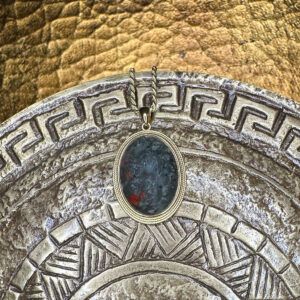
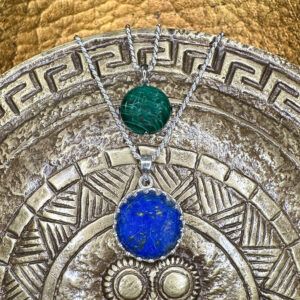
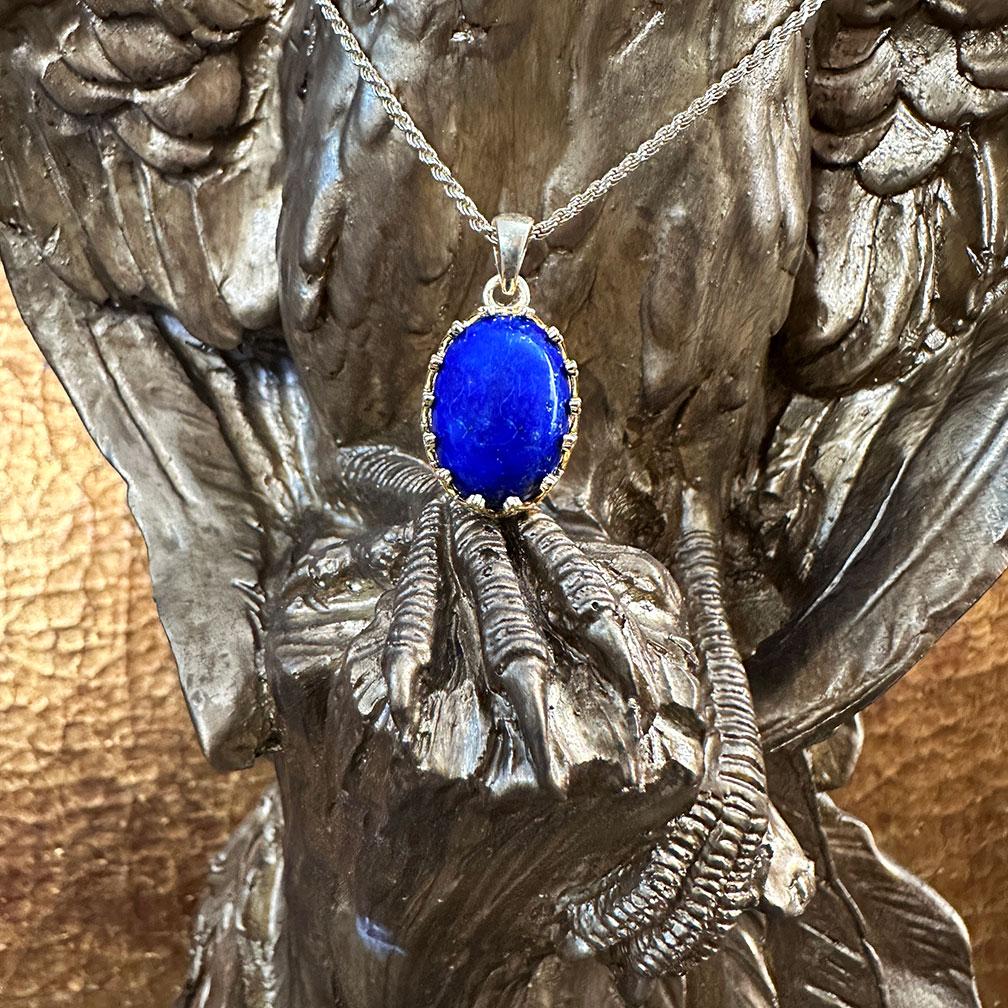
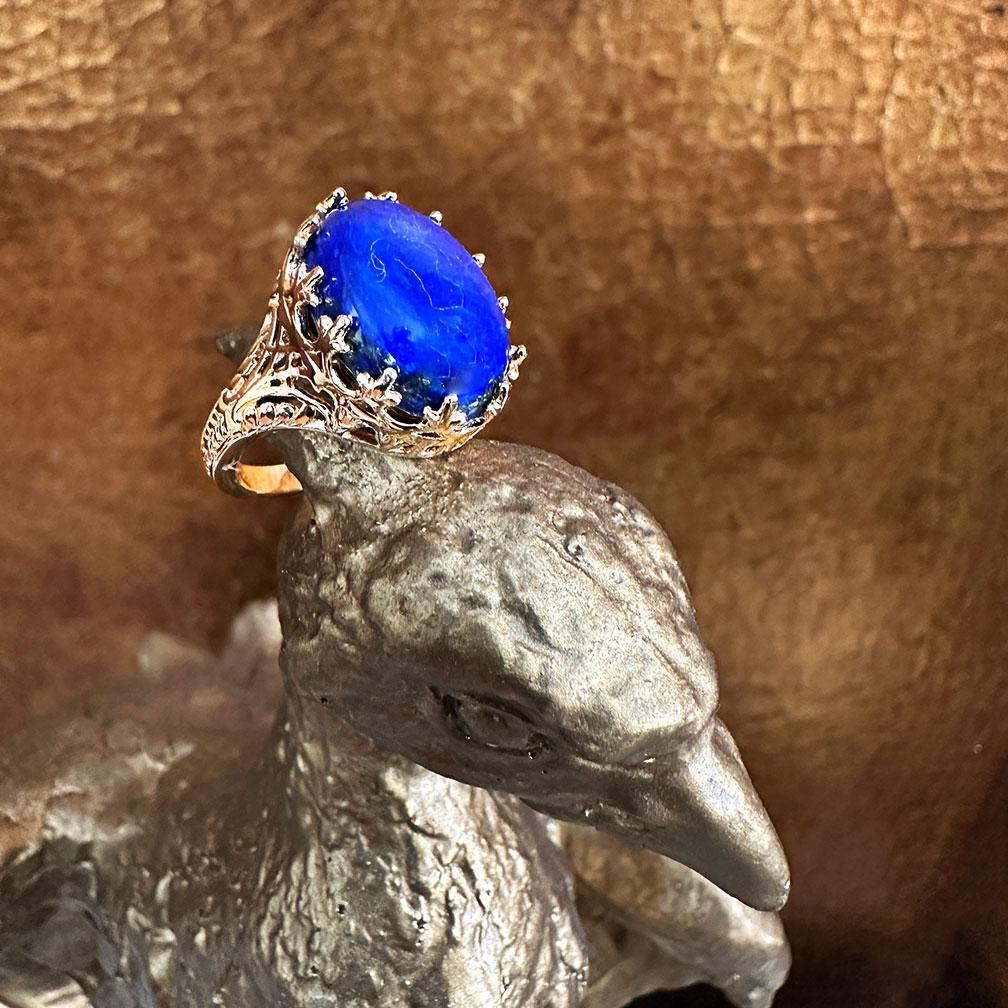
Two stones were used in this election. The modern lapis lazuli was referred to in Greek as σάπφειρος and in Latin as sappirus and later saphirus, with the name ‘sapphire’ not given its modern assignation to blue corundum until later in history. Lapis lazuli in ancient times was canonically blue azurite with golden flecks of iron pyrite, with Babylonian and Greek sources using different names for other variants that fall under the modern heading of lapis lazuli (e.g., solid blue, or blue with white calcite but without iron pyrite). According to Earle Radcliffe Caley and John F.C. Richards, translators of On Stones by Theophrastus:
“It is certain that the σάπφειρος or sapphirus of the ancients was not the same stone as the transparent blue gem now called the sapphire… [the descriptions in ancient sources] can only apply to dark-blue lapis lazuli containing disseminated specks of iron pyrites… Lapis lazuli of solid color, or at least the kind that did not contain conspicuous amounts of pyrite, was given the name kyanos.”
Saphirus was held by the ancients to have a variety of positive effects. The influential medieval lapidary of Bishop Marbode of Rennes attributes such benefits as preservation of health, protection from harm, and the power to soothe negative emotions such as envy and melancholy. The entry in the Peterborough Lapidary for “Saphyr” clearly refers to lapis lazuli, and lists among the many benefits of this stone that it “destroy[s] foulness and envy, and comfort[s] the body and limbs” (tr. Francis Young, p. 64), and that it is “very good to bring men together” (p. 65), has “the virtue to comfort and gladden the heart” (p. 66), is good “against all melancholy passions” (p. 66), and “does away with sorrow and dread” (p. 66-7), all significations fit to these Venus talismans.
The stone known in contemporary times as rose quartz is somewhat harder to place, as the word ‘pink’ that we would use to describe the color was not in the lexicon until the 18th century. Dorothy Wyckoff, translator of Albertus Magnus’s Book of Minerals, believes that the stone hyacinth, later jacinth, referred to rose quartz (among other stones, as there were different colors of hyacinth in antiquity). Although hyacinth is not attributed to Venus in astrological texts, we have had success (and divinatory go-ahead) to use rose quartz in this and past Venus elections (see our Shelter talismans from the Solace collection). Picatrix notes that “the color of Venus’ garments is rose” (bk. III, chap. 3), supporting our association of this stone with Venus.
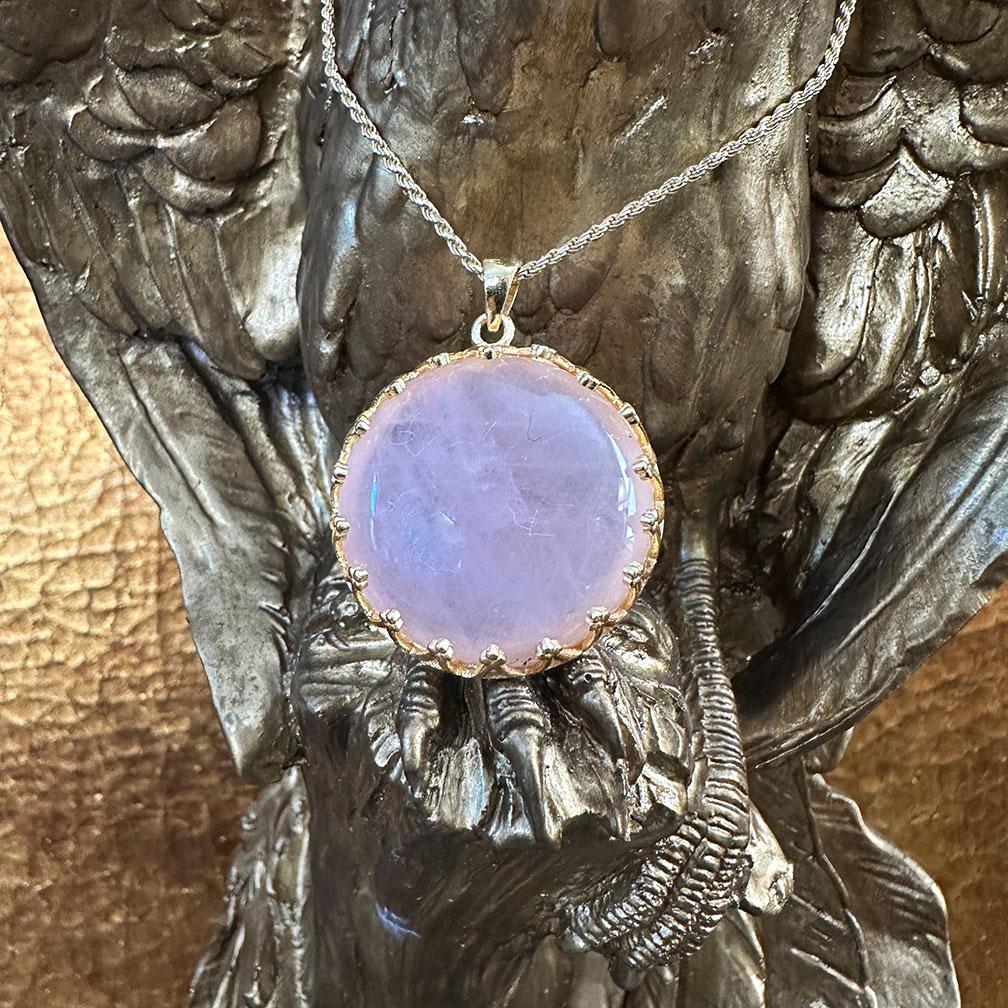
The lapis lazuli and rose quartz cabochons were carved with an image from Book II, Chapter 10 of Picatrix: “the form of a woman, holding an apple in her right hand and a comb in her left hand.” Those who carry this talisman are supposed to “always laugh and be cheerful.” On the obverse of the talismans we carved the symbol of Venus and sigil of her planetary intelligence, and affixed powered rose petals, a canonical herb of Venus.
Ritual Setup
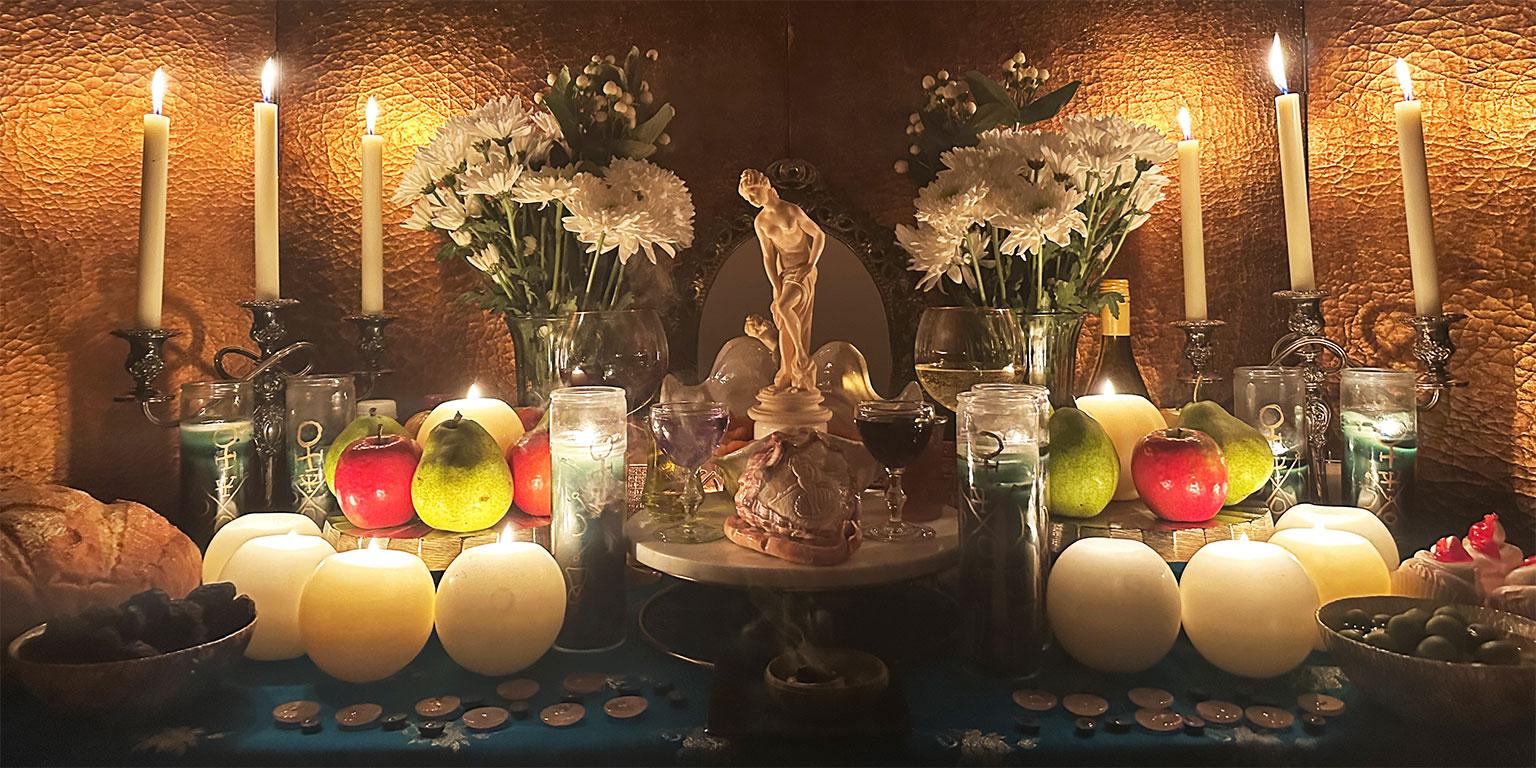
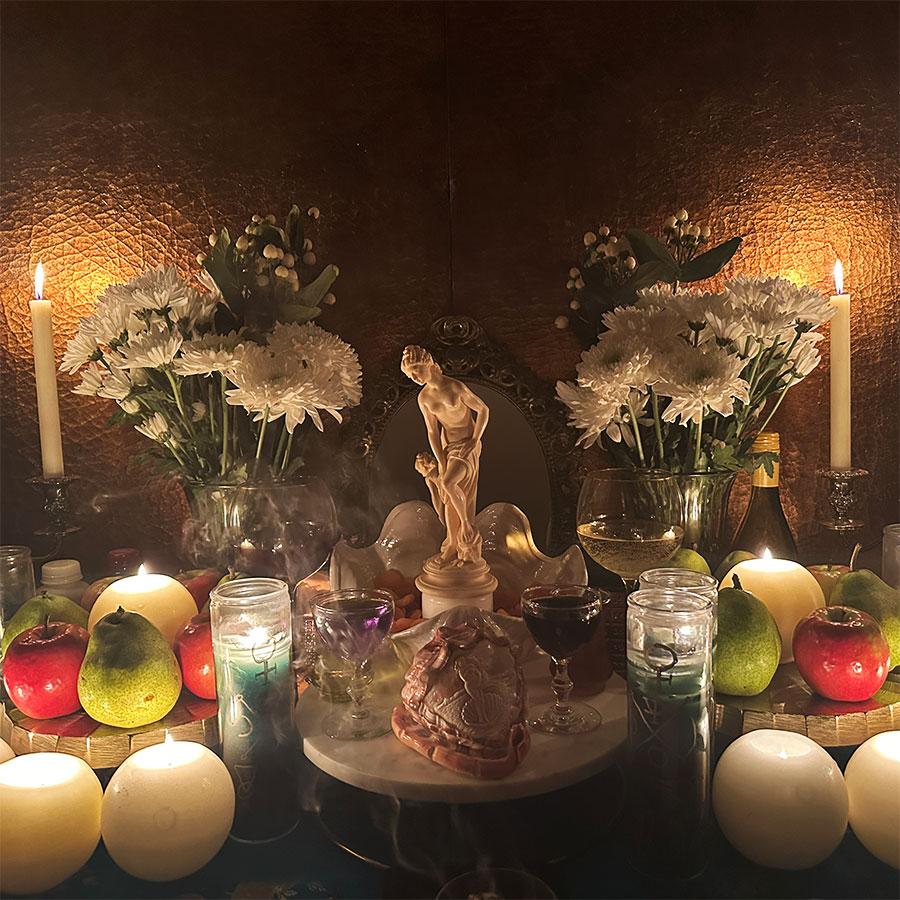
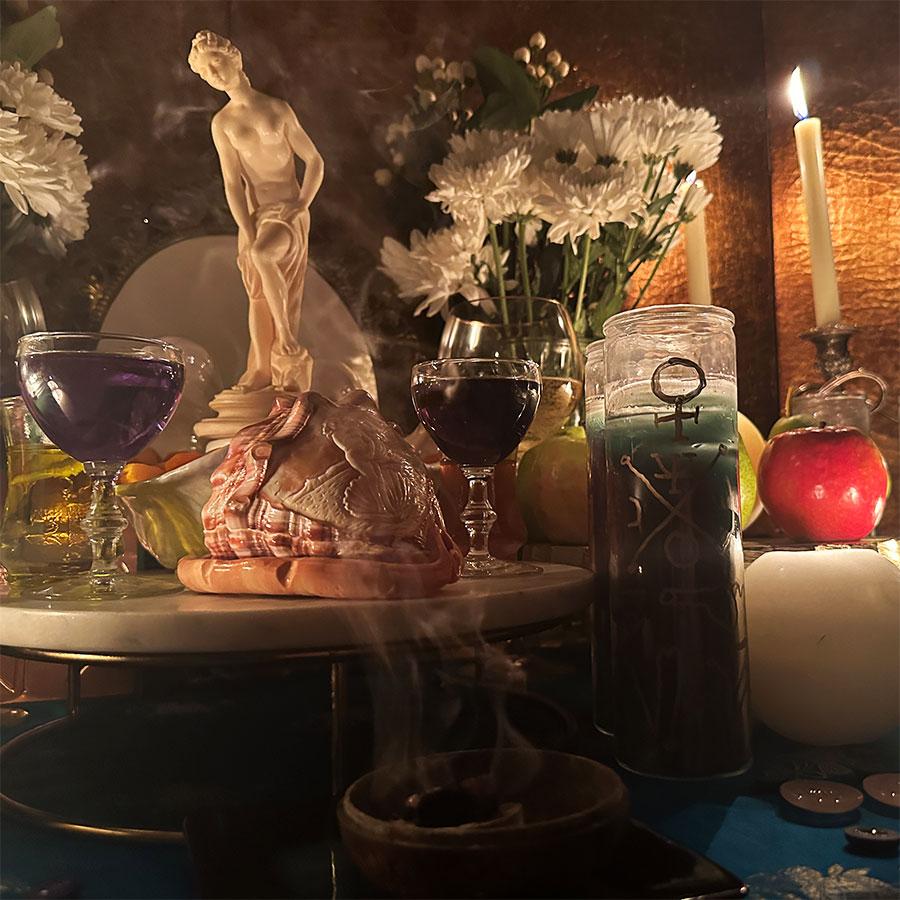
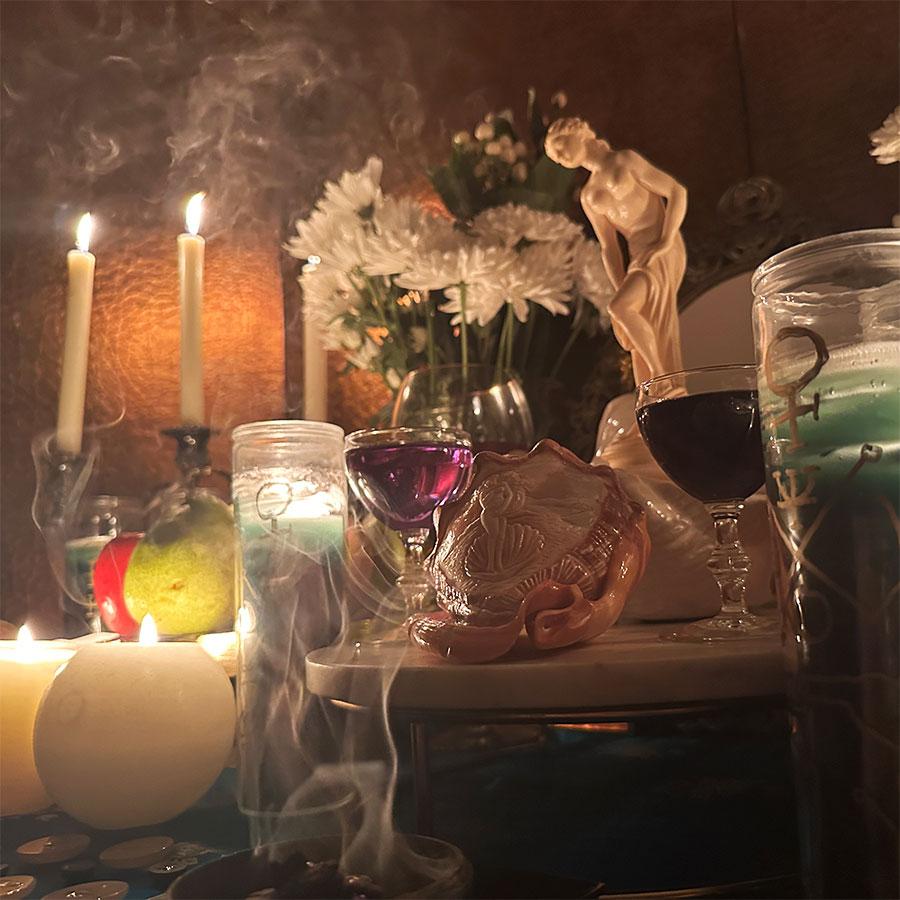
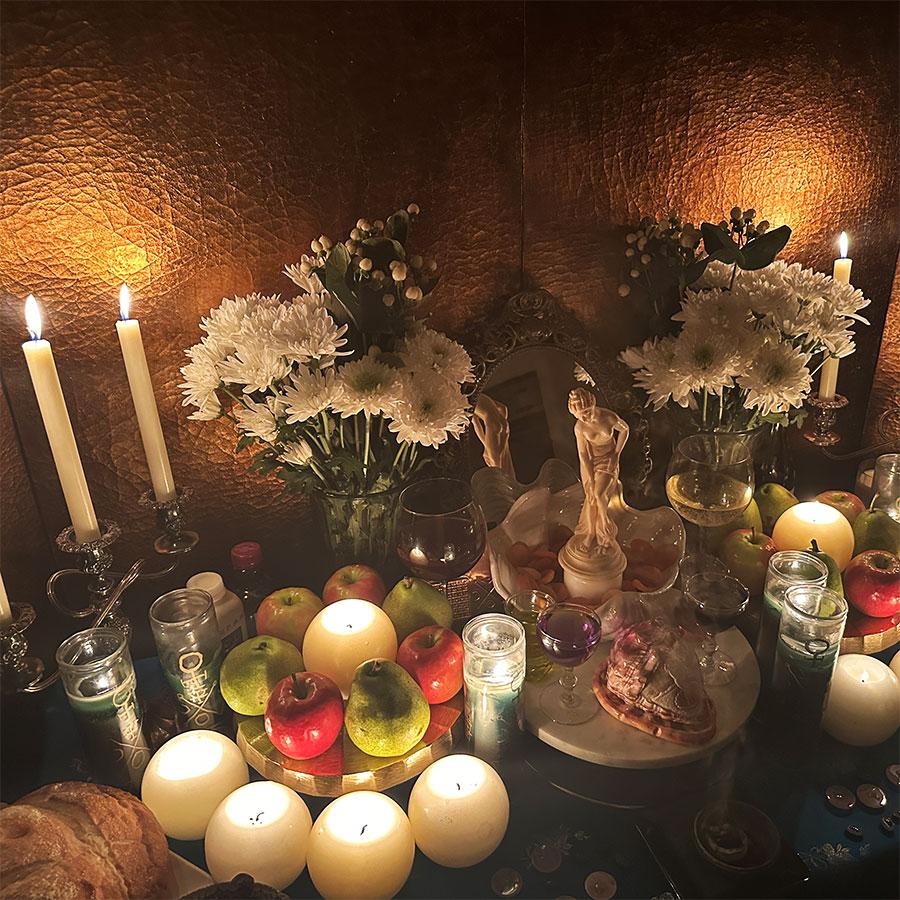
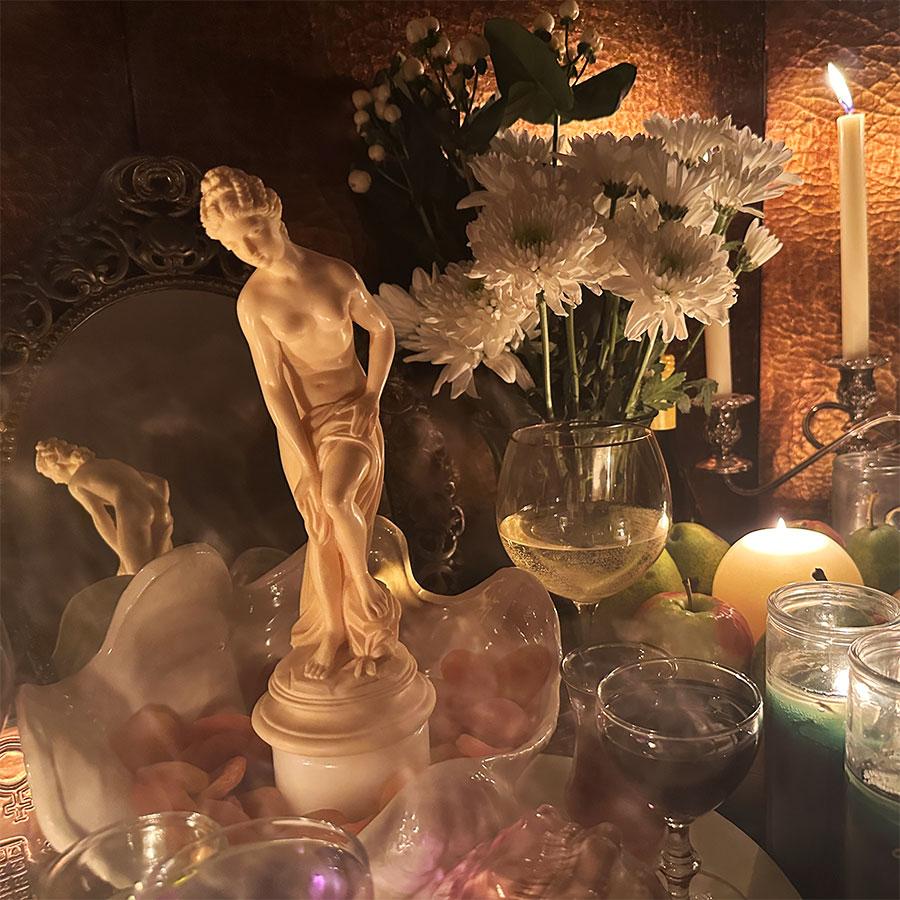
An altar of blue and green and gold was established prior to the working, with a statue of bathing Venus atop a large porcelain shell serving as the centerpiece of the working. A carved conch shell with the image of Venus that we found at a beloved local antique market leading up to the election also graced the altar. Copious candles illuminated the working, including seven ritually consecrated to Venus emblazed with her symbol and seal as well as the sigil and planetary square of her planetary intelligence. Fresh white flowers served as plant offerings, and generous food offerings including pears and pink lady apples, Greek olives, strawberry cupcakes, fresh bread, and dried apricots and figs were made to Venus, with glasses of wine, honey, olive oil, and spirits rounding out the offerings.
At the outset of the working, venusian incense (described below) was offered with invocations of Venus by many names and epithets, her planetary angels, and the rūḥāniyyat (spiritual beings, akin to daimones, held by some to be angels) of Venus’s sphere. A bespoke petition requesting venusian benefits of mirth and joy was made prior to the carving of the stones, affixation of herbs, and suffumigation, all of which took place within the stated electional window according to our guarantees. Upon completion of the operation, the ritual was formally closed with gratitude and license to depart given to the spirits of Venus.
Suffumigation
The suffumigation for the Mirth & Joy talismans was produced according to a modified recipe that appears in Picatrix in the section on Venus in the chapter in celestial petitions: “Take aloes wood, gall, costus, saffron, opium, mastic, poppy hulls, willow leaves, and orris root in equal parts. Grind them all and mix them with rose water; make from this pills the size of a fava bean, which you cast into the fire of the thurible when you perform this working” (Book III, Chapter 7). For our version of this recipe, we used Cambodian aloeswood, Aleppo oak gallnuts, Spanish saffron, Greek mastic, locally harvested willow leaves, and orris root. As opium is obviously not legal, we made appropriate substitutions and bound the ground ingredients together with rose water.